Targeting Final Consonant Deletion Using The Cycles Approach for Speech Therapy
If you're working with a preschooler who drops final consonants, you know how much this pattern can affect intelligibility. A child who says ca- for cat, bu- for bus, and cu- for cup may be difficult for unfamiliar listeners to understand, especially when several phonological patterns are happening at once.
The Cycles Approach gives us a way to target these patterns without getting stuck waiting for a child to master one sound before moving on to the next. But when you're planning a session, it can still be hard to figure out exactly what to do with your time.
Let's walk through how I might organize a 20-minute session targeting final consonant deletion, including some ideas for choosing target words, building in practice, and keeping things moving when a child is having a tough time. Note: If you are doing 20 minute sessions…let’s say in a school setting…you need to do 3 session for each phoneme in the pattern. For more about Cycles scheduling, check out my Complete Toolkit.
Start with your Cycles targets and word list.
Before choosing an activity, I want to know which final consonants I'm targeting and which words will give the child opportunities to practice them.
For a child who is deleting final consonants, I might choose phonemes and words such as:
final /t/: hat, mat, pat
final /p/: cup, hop, map
final /m/: game, name, bam
These are examples rather than a prescribed word list. The actual targets and stimuli should be selected based on the child's speech patterns, the current cycle, and the facilitative contexts you're using. You will also decide if you are going to use 2, 3, 4, or 5 target words.
I also want to consider how familiar the words are to the child. If I'm working with a preschooler, I generally prefer words that are meaningful and easy to incorporate into play. There's not much benefit to choosing a word that the child doesn't know if I'm trying to get lots of opportunities for meaningful speech practice.
Again, check out the Cycles Toolkit for primary patterns, possible phoneme targets, and word lists. All words were chosen with little ones in mind…words they will actually know.
What could a 20 minute Cycles session look like?
Let's say I'm targeting final consonant deletion and have selected a set of words to practice. Here's one way I might organize a short session.
Minutes 1–2: Listening activity
Start with a brief listening activity using your target pattern and phoneme. You can read a word list while the child listens with amplification.
For example, if you're targeting final /t/, you could use words like cat, hat, and boat.
The listening activity should be short and purposeful. I don't want to spend a large portion of the session on listening when the child also needs opportunities to produce the words.
Minutes 3–12: Practice your target words
This is where I want to build in plenty of opportunities for the child to say the target words.
You don't need an elaborate activity to make this happen. A simple game, toy, or book can provide enough context to keep the child interested while you work on your targets.
For example, if you're targeting final /p/, you might use a small cup, a toy map, or a person figurine that can hop and nap. The child could ask for the cup, find the map, or tell you where the person hops and naps. I like to use multiple Little People and have them all nap and hop…tons of practice.
The activity is there to support practice, not to take over the session. If I'm spending more time explaining the game than getting speech practice in, it's probably time to simplify things.
Minutes 13–17: Keep practicing with a little variety
At this point, you could switch activities depending on the child's needs and the plan for the session.
Sometimes a small change is enough to keep a preschooler engaged. You might move from a toy activity to a quick picture-card game, or take the same words and use them in a different play routine. Using picture cards for a memory match or a hunt around the room is a great way to get in lots of practice. Just make sure the child has to produce the word 3-5 times before moving turns.
The goal isn't to squeeze in as many activities as possible. It's to give the child additional opportunities to practice the target pattern while keeping the session manageable.
Minutes 18–20: Review and wrap up
Use the last few minutes to revisit your target words, reread the listening list, and give the family a simple idea for practice at home.
You might choose two or three familiar words and encourage the parent to model them during an everyday activity, such as getting a cup, putting on a hat, or looking at a book.
I wouldn't send home a complicated activity that requires the family to recreate your entire therapy session. A few meaningful opportunities to hear and practice the words can be a much more realistic starting point.
Keep in mind that this is a flexible example of how you might organize a short session, not a required Cycles session format. Your activities, timing, and number of targets will depend on the child and your treatment plan.
What if the child isn't producing the final consonant?
This is where I think it's helpful to have a few strategies in mind before the session starts. If a child is consistently deleting the final consonant, I don't want to spend the entire session asking for a word they aren't able to produce.
Here are a few things I might try.
Model the whole word. If the child says cu- for cup, I can provide a clear model of cup, with the final consonant emphasized enough to draw attention to it without making the word sound unnatural.
Use a visual or gesture cue. Sometimes a simple reminder that there's a sound at the end of the word can help the child attend to the final consonant. I might use a gesture that moves toward the end of the word or a visual picture cue that reminds the child to include the last sound.
Adjust the word or context. If a particular word is consistently difficult, I may need to look at whether the word is appropriate for the child, whether the target is stimulable, or whether the context is making production harder. Don’t be afraid to throw out a word and replace it with an “easier” one.
The Cycles Approach isn't about waiting for a child to master every target before moving forward, so I want to be thoughtful about how I'm using my time and what the child is getting out of the session.
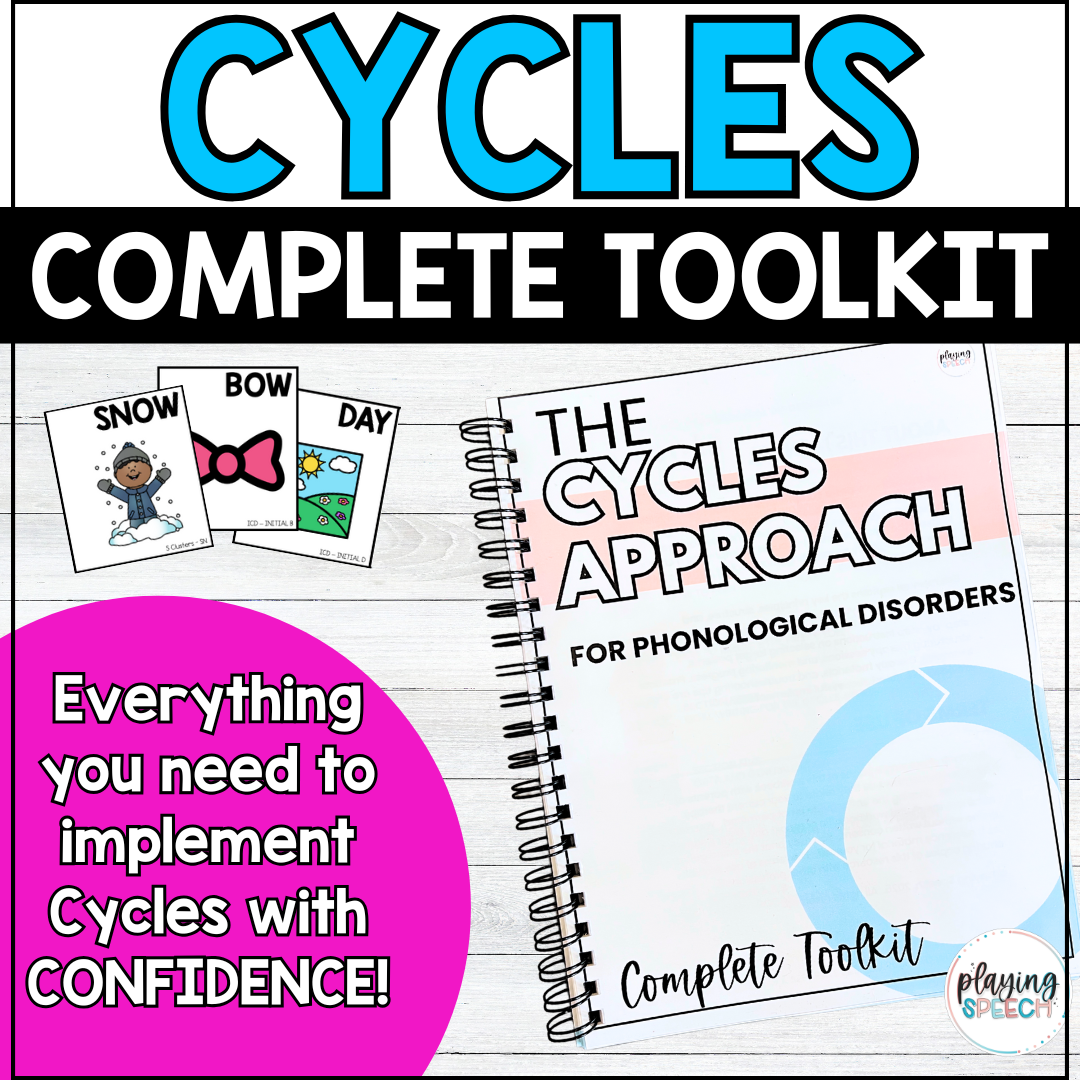
This is a complete toolkit for learning and using the Cycles Approach for Phonology in speech therapy. The Cycles Complete Toolkit makes it simple and easy to understand the Cycle Approach - no more guesswork or flipping through a million different resources! It includes checklists, forms, step-by-step walk throughs, and even a sample client so you can see exactly how to implement the Cycles Approach in speech therapy!
Not only does this product include the research, and the step-by-step instructions on how to implement the Cycles Approach, but it also includes ALL the stimuli you will need to get started. Literally a "one stop shop."
Includes:
****recently updated (3/17/25) to include even more handouts and forms****
Over 60 page how-to manual
Step-by-step instructions on how to implement the cycles approach
Therapy planning sheets and forms
Target selection sheets and forms
Data sheets
Over 220 stimuli cards
Auditory bombardment word lists
FAQ about the Cycles Approach
Sample goals for use with the Cycles Approach
What a Cycles session looks like: step-by-step AND visual printable
Sample client - shows you EXACTLY how to plan a first cycle
Phonological Awareness Activity Ideas
My go-to therapy Activity Ideas
Homework Sheet
Generalization Check Data Sheet
What one reviewer said:
⭐️⭐️⭐️⭐️⭐️
Not only is it beautiful, but it's comprehensive, supportive, research-based, and very clear. Your examples and samples throughout would make me immediately confident in using cycles and this toolkit. You also made the forms so simple for SLPs to use on the go, like so complete where everything they need is there, but won't take a million years to fill out.
Make your Cycles planning a little easier.
If you're working with several preschoolers who have multiple phonological patterns, planning can become a lot to keep track of. You're choosing patterns, selecting words, organizing stimuli, and trying to keep sessions moving while making sure you're following your treatment plan.
This is exactly why I created my Cycles Complete Toolkit.
It's designed to help SLPs organize their Cycles planning with pattern-specific materials, word lists, forms, and other resources you can use to prepare for therapy.
Instead of starting from scratch every time you're planning a session, you can spend more of your time thinking about the child in front of you and less time pulling together materials.
Happy speeching!