How to Teach the R Sound in Speech Therapy: 6 Steps to Mastery
The Dreaded R Sound: A Way to Teach the R Sound That Actually Works
You know that one sound that makes even the most seasoned SLPs question their entire career path?
Yeah. R.
I mostly work with younger guys, so I could sort of sidestep the R problem for a while. But lately, a few older students—first, second, and fourth graders—have landed on my caseload with one very specific need: that pesky R sound.
I won’t pretend to be an R expert (does such a thing even exist?), but I have put together a method that’s been surprisingly effective. And if it’s helping my students, I figured it might help yours, too.

Step 1: Lay the Groundwork for the R Sound
Before I even touch the R sound, I focus on oral awareness and control. Huge shoutout to Char Boshart here—this part of the process is all about building foundational skills like tongue placement, stability, and jaw control. It’s a “get to know your mouth” kind of vibe, and trust me, it matters.
So, some may say NSOMES?!?! But I see these as stepping stones to overall awareness of what the tongue can do and conscious CONTROL - which is critical for any speech sound. Can't make a sound if you can't get placement, amiright?
A lot of this is from Char Boshart and Pam Marshalla.
Some oral awareness and capacity building tasks we do:
“Fat vs. skinny” tongue: We need a wide flat tongue to get the sides braced on the lateral molars.
Tongue bowls: We need to get the sides of the tongue up. We don’t do a full taco tongue - although I WILL use the taco as a step to the bowl if I have to.
Tongue retraction: The child needs to understand what it means just to pull the tongue back - and flat, not curled - into the mouth.
Tongue suction to the roof of mouth: We do the suction then drag it slightly backwards in the mouth. I then have the child work on gently releasing the suction but not letting the tongue drop completely. If they can do this, this usually leads to nice lateral margin bracing with medial depression (a bowl), and retraction. It’s like almost all of the major components for the R! I also feel like it helps them grasp that idea of tension.
Now, I want to mention that this is not the BULK of my treatment. It is a starting point. And crucial IMO. The child needs to have conscious control of their tongue and awareness of the anatomy in order to get the placement for the R sound!
At this point, we also discuss the anatomy of the mouth so the child and I have a common vocabulary about where the articulators need to go. We also discuss what specifically the tongue needs to do for the R sound: sides up, back down, pull back in the mouth, tip up. We will use pictures or a giant mouth model. Whatever works.
Step 2: Elicit a Solid “ER” (or ARE or EAR!)

Next, I zone in on just one target: a clean, strong “ER” (like in “her”). If “ER” by itself is too hard, sometimes we use the faciliative vowels in “ARE” and “EAR”. Don’t worry about any other R variation. I promise. Just focus on the whichever of the 3 (ER, ARE, EAR) is easiest to achieve.
To get the “ER, ARE or EAR”, I pull out every cue, visual, and trick in the book. There is no one magic cue either, sorry. The right cues are the ones that work for the child in front of you!
And, we stay here as long as it takes. Sometimes, the child is so close, but not quite getting it. I’ve even said, “Just move the tongue around a little bit. Play around with where it goes and see how that changes the sound.” Since the child is familiar with what the tongue CAN and SHOULD do, sometimes that’s all it takes to push us over the hill.
If I hear one good “ER, ARE, or EAR” we freeze! And then immediately try to replicate it. Sometimes I have the child hold out a long “ER, ARE, or EAR” and close their eyes to feel what the mouth is doing. But, once the sound clicks, everything else starts falling into place.
Step 3: Drill the Heck Out of It
Once “ER, ARE, or EAR” is solid, we drill it—hard. We’re not jumping to words or sentences yet. Just “ER, ARE, or EAR” in isolation, again and again and again. Think hundreds of reps per session (thanks, SATPAC, for the inspiration). I want “ER, ARE, or EAR” to be second nature before we move on. It needs to be automatic and effortless to just “hit that sound.”
Step 4: Increase Complexity
When “ER, ARE, or EAR” is automatic, I start to increase complexity. But we do this is a systematic way. And I have to mention, again, this is all adapted from SATPAC.
er, are, or ear + /g/ sound + different vowels (e.g. eargah, eargo, eargoo, eargay)
er, are, or ear + all different consonants + same vowel “ah” like in “apple” (e.g. "eargah, earvah, earmah, etc.)
er, are, or ear + different consonants + different vowels (e.g. earkah, earlow, earmoo) *sometimes we can skip this step if we can isolate the “er”
initial consonant + ER
We are really intentional here about transitions and smooth blending. If one beginning sound is more difficult than others, we will focus in on it and drill it even more. So, let’s say L + ER is harder to produce. Then I pull that out and we work on getting it smooth and effortless.
Step 5: Conquer the Other Vocalic Rs
Here’s where things get fun. Using a “vowel + ER” approach, we build out all those tricky vocalic R sounds: “air,” “ear,” “ire,” and so on. For example, for “air,” we start with a clean “ay” and slide into “ER.” Once you’ve got a dependable “ER,” this part feels like magic. I spend as much time here as needed - just getting the vocalic R variations. But then, we will do simple words. Check out this freebie I made for all vocalic R sounds in various positions of words.
Step 6: Tackle Initial R and Clusters
Honestly? Once “ER” is automatic, initial R and R-blends become so much easier. They’re basically just “ER” in disguise. With enough practice, these placements feel like no big deal.
And That’s It! Now You Can Teach the R Sound in Speech Therapy!
It’s not flashy, but it’s systematic—and most importantly, it’s working. Start with some oral awareness, get a solid ER, and I feel like the rest will be downhill!
I’ve got a rising third grader coming in this summer to work on R, and I’ll keep you posted on how this method holds up with her!
Some R Speech Therapy Resources for You:
Before you go, I want to share a few materials I’ve created specifically for the R sound. Once my students have the basics down, these tools help with carryover, generalization, and randomization of practice to keep things fresh and challenging.
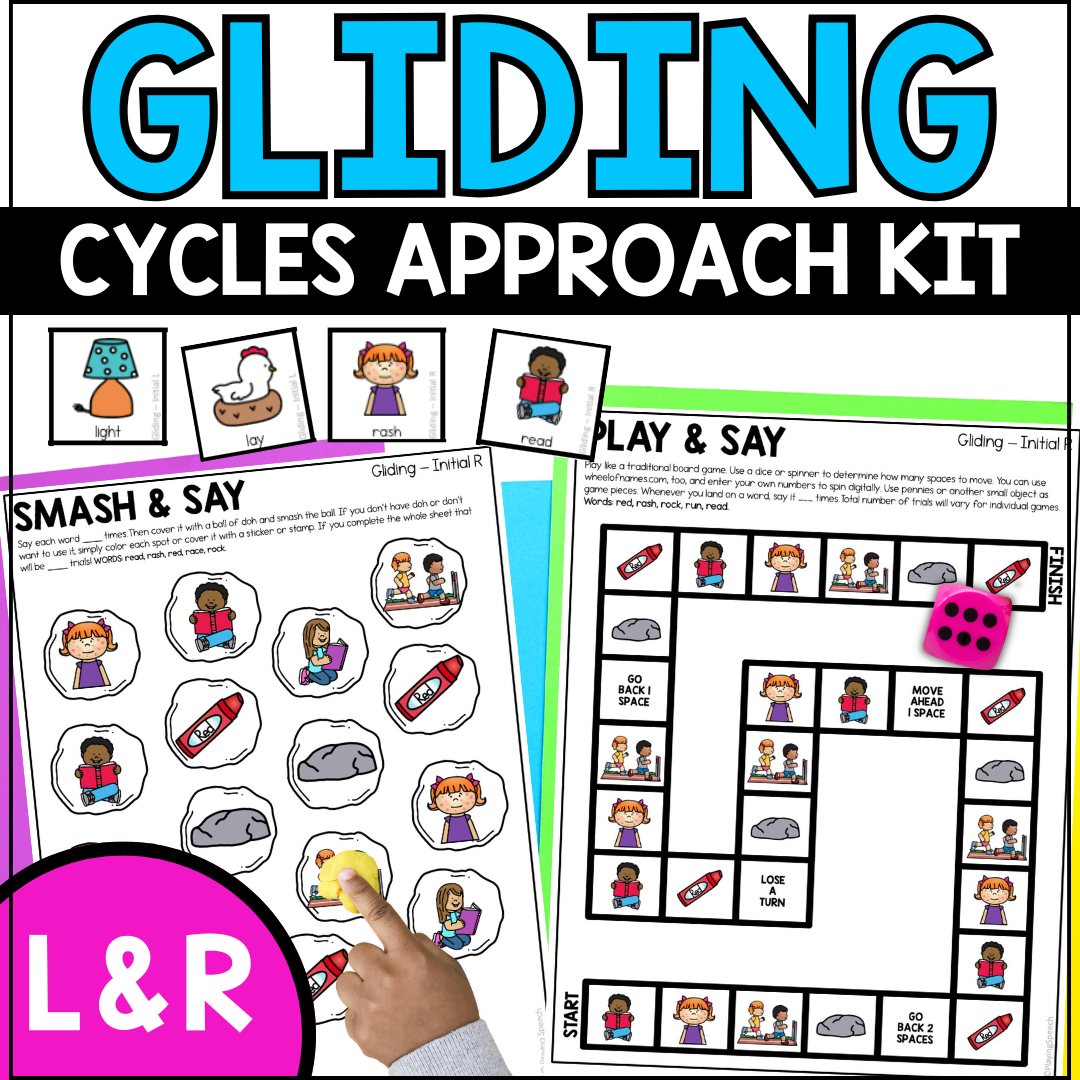
Take the guesswork out of implementing the Cycles Approach for Phonology in speech therapy...and never run out of Cycles activities while also getting 90-100 practice trials easily!
This Cycles Approach Kit includes NO PREP speech therapy activities and mini flash cards with carefully chosen target words so you can implement the Cycles Approach with ease.
It includes color and black and white activity pages to use when you are targeting gliding (initial R and initial L) during the Cycles Approach. Just choose your activity and print & go!
WHY YOU NEED THESE:
Use hands-on activities and games in speech therapy sessions to easily get HIGH practice trials.
SO many activities included PER SOUND to choose from. Never run out of activities!
Keep little hands busy with fine-motor tasks: tweezers and mini erasers, magnetic Bingo chips, paint daubers, coloring, play doh and MORE!
Use the mini flash cards with your Cariboo or other speech therapy surprise toy favorites!
Easily send the no prep worksheets home for Cycles homework.
Make simple summer speech packets.
Laminate and reuse the color game boards, smash mats, and tracing pages over and over again!
You can use this product digitally with PDF markup tools. Draw and color right on the black and white PDF pages!
INCLUDES:
30 NO PREP Color and Black and White Activity Pages
Say and Check Pages
Trace and Say Activities
Doh Smash Mats
Say and Dot Paint Dauber Pages
Roll and Cover Pages
Search, Find & Color Pages
Coloring Pages
Spin & Cover Page
Cut and Glue Pages
Game Board Page
Mini Flash Cards (Cariboo Size!) for Initial L and Initial R
Auditory Bombardment Word Lists
Activity Ideas Page
Caregiver Letter
Cycles Info Pages

Teach the Vocalic R sound using these coarticulation activities in speech therapy! No print and no prep articulation activity option included! You will be shaping vocalic R from prevocalic/initial R. The student who is appropriate for this resource already has a good initial R sound, but is struggling with the vocalic R. So, we are using that initial/prevocalic R to help get the articulators in the right spot for the vocalic R.
How to use this resource:
When using this resource, have the child say a vocalic R word immediately followed by a prevocalic R word. Then you fade out the production of the prevocalic R. I use the arrows as a way to help the child slide their finger or a tiny manipulative from the vocalic R to the initial R sound. This is great for a visual and tactile cue!
Choose the prevocalic R word that helps your client get his/her best R sound. Start with Level 1 cards where the child will say the ENTIRE prevocalic R word after saying the vocalic R word. I like to “hold out the R” that I am blending as we slide our finger or a tiny manipulative along the arrow joining the words. (e.g. carrrrr -> Red).
Then move to Level 2 where the child will either (1) say the initial R normally and whisper the end of the vocalic R word (e.g. so normally say the R for “red” and whisper “ed”) or (2) start to say the prevocalic R word but omit the ending altogether (e.g. say ”R” for red but don’t complete the word). You can still drag out the R to help establish that placement (e.g. carrrr -> R). These are two ways I fade out using the prevocalic R word to help shape that vocalic R.
Tell me about the target words…
All the words in this resource (the vocalic R words AND the initial R words) were chosen for their facilitative contexts! Although not every word is perfect (that would be impossible, right?) this is a GREAT place to start when shaping vocalic R from prevocalic R because the student is set up for success!
The initial R words are consistent across all vocalic R trials. There are 6 different initial/prevocalic R words to use for coarticulation, each with a different facilitative vowels following the initial R (red, read, rug, rash, rob, rip). Choose the one that is best for your student. There are also 5 different words for each type of vocalic R (e.g. 5 words for “air” and 5 words for “er”). Each of the vocalic R words is paired with every type of initial R, so you have plenty of contexts to choose from!
WHAT IS INCLUDED:
Level 1 Coarticulation Cards - Color
6 different coarticulation words
6 different vocalic R (air, er, ar, ire, or, ear)
Level 2 Coarticulation Cards - Color
6 different coarticulation words
6 different vocalic R (air, er, ar, ire, or, ear)
The end of the initial R word is in fine/dotted print. This is so the student gets the visual that they are NOT going to say the entire initial R word. Rather they are only going to say the initial R sound. (This is the initial R sound that they are already good at.)
Level 3 Simple Sentence Strips - Color
6 different sentence strips; one for each prevocalic R coarticulation word
Change out the target vocalic R word for all 6 vocalic Rs
Level 1 & Level 2 cards in no prep black & white
Print and go OR
Pull up on a PDF reader and use digitally with mark-up tools OR
Send home for speech therapy homework

Do you need R SOUND no prep articulation worksheets for speech therapy activities? Are you tired of buying articulation worksheets that only contain 1 worksheet for each target speech sound? I was, so that's why I created these no prep R SOUND articulation activities! Use these no prep articulation worksheets for the R SOUND in your speech therapy sessions or easily print off and send as speech therapy homework. Great for speech therapy summer packets!
Just print and go! Truly a grab and go articulation resource! Designed to get you high articulation trials in simple, engaging, hands-on activities! This packet will have you covered for the ENTIRE YEAR with your students who are working on the R SOUND in speech therapy!
Each page is designed to get HIGH trials - 50 or more! Instructions included on every page!
Includes over 60 no prep articulation worksheets for the R SOUND.
This resource includes:
18 initial R worksheets
6 AIR worksheets (mixed positions)
6 ARE worksheets (mixed positions)
6 EAR worksheets (mixed positions)
6 ER worksheets (mixed positions)
6 OR worksheets (mixed positions)
6 IRE worksheets (mixed positions)
6 MIXED VOCALIC R worksheets
Easily incorporate fine motor skills, cutting, number sense, and phonological awareness with all the different HANDS-ON activities!
Uses:
in your speech therapy sessions to get high trials
send home for speech therapy homework

Phonological awareness activities for speech therapy specifically targeting the R sound! This resource includes everything you need to blend articulation activities and phonological awareness activities for more effective speech therapy! Sample activities include: rhyming, syllable counting, sound sorting, initial sound identification, blending, segmenting and more ALL related to a child's target speech sounds!
You know children with speech sound disorders have an increased risk of poor phonological awareness skills, and you want to incorporate phonological awareness activities in your speech therapy sessions. But, you're unsure how to do that easily and effectively.
So, let me help you! I created this resource so you can effectively target both phonological awareness and speech sound goals ALL at once!
This resource includes over 80 no prep pages targeting a wide range of phonological and phonemic awareness skills related to the R sound! Each sheet is designed to be hands-on and interactive to keep little ones engaged while getting lots of practice.
Tons of different skill levels included so you have a phonological awareness activity for any phonological awareness skill level on your caseload from rhyme identification to blending!
Activities included:
rhyming activities
syllable counting activities
same sound identification
1st sound identification
last sound identification
which word doesn't belong (find the word that doesn't start with your sound)
find your sound (beginning, middle, or end of word)
grapheme identification
blending activities
segmenting activities
This resource breaks up the R sound into initial R and vocalic R variations. That means there are pages dedicated specifically to each individual vocalic R sound! If you just want to focus on "are" you can do that with this resource!
Sounds included:
initial R
er
ear
air
are
or
ire